|
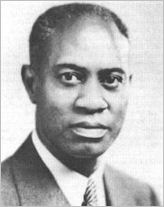
Melvin B. Tolson: Revisited by Robert
M. Farnsworth It was 1972. I was sitting in my office when David Ray, the editor of New Letters, plopped a manuscript on my desk and said, “Read this and tell me what you think.” It was a piece on Melvin B. Tolson by Roy P. Basler, who was then editing the collected works of Abraham Lincoln and serving as Chief of the Manuscript Division of the Library of Congress. Basler argued that “Tolson is perhaps the poet of our era who best represents, or comes nearest to representing, in his comprehensive humanity, the broadest expanse of the American character, phrased in the richest poetic idiom of our time. Better than his contemporary peers, he knew the span from low-brow to high-brow in both life and literature, and he loved the American English language, from gutter to ivory tower, better than any of them. His poetic diction is a natural blend of home words and hall words, where hearth and bema sing side by side.”[1] Like many others, I had flinched at the difficulty of Tolson’s major poems and was passively content with the general recognition of his anomalous and marginal position in the canon of black poets. Even so, I was convinced we should publish Basler’s essay. But as I read it now I am embarrassed that while recommending it, I did not fully appreciate how telling a breakthrough it was. Basler picks up on Allen Tate’s praise of the opening stanza of Libretto for the Republic of Liberia: Liberia?
But Basler goes beyond Tate: “he [Tolson] begins in sarcastic good humor at the expense of learning and poetry, with a metaphor that only a great poet with a great sense of humor could devise or laugh off the pomp of his proud occasion as Poet Laureate of Liberia, and follows it immediately and miraculously with magical reversal of image to exalt the living truth which escapes not only his occasion, but all occasions, and all words.” Basler praises Tolson for abandoning the humorless restraints of the New Criticism and reveling in the pleasure of blending comic and heroic, as well as comic and tragic, in a uniquely personal flight of poetry. He also finds Tolson’s equally flamboyant serio-comic footnotes a delight.[2]
To illustrate Tolson’s bold Jovian humor Basler cites
another “enormously pregnant passage” with its
challenging footnote. Like some
gray ghoul from Alcatraz
Paseq: “divider.” This is the vertical line that occurs On this Basler comments: “How abstrusely appropriate a 'visual' word can a poet find to name his personification of the motive most extolled in the gospel of capitalism by Chamber of Commerce evangelists? Not merely as a 'vertical' dispenser of intoxicants to the habitués of this whore house, but also something Tolson does not tell us, the not-at-all mysterious use of the paseq in the Hebrew Bible, namely to call the tune, so that the reader will not read two words together that should properly stand apart. “What Tolson undertook, I think, with great success, was to liberate the allusive, scholarly poetry Eliot created from the service of Eliot’s sterile tradition and philosophy, and , while embellishing it with large humor, to put it to use as a vehicle for his own ‘progressive’ view of human history.”[3] The distinction Tolson draws between Pleasure and Art in “Theta” of Harlem Gallery again for Basler underlines Tolson’s robust claim for art: The claw-thrust of a rutting tigress, the must of a rogue elephant— these con the bull of predictability, like Happiness, a capriccio bastard daughter of Tyche.
KKK, the beatnik guitarist, used to say to High Yellah Baby (before he decided to rub out the light of his eyes in the alley of Hinnom behind the Haw-Haw Club): “The belle dame—Happiness—the goofy dream of is a bitch who plays with crooked dice the game of love.”[4] Tolson died in 1966, when black nationalism was becoming an insistent critical force. His poetry seemed to many to owe too much to white civilization. But Tolson believed that ultimately race was one of “The Idols of the Tribe.” As Basler points out, he believed that “One could be a man, and proudly a Negro, especially a poet, without specializing in being primarily the Negro on the one hand, or apologizing for being one on the other.” He believed in writing for “The Man Inside.” He confronted “the white and not-white dichotomy/ the Afroamerican dilemma in the Arts--/the dialectic of to be or not to be/a Negro.” Black people had made great contributions to world civilization that had long gone relatively unrecognized. They were still doing so. The Harlem Gallery he envisioned in his poem was itself to be the means of the black artist assuming and winning his rightful role in the evolution of a more just and aware future world: White Boy Black Boy, What if this Harlem Exhibition becomes a cause celebre? . . . . . . . . . . . . . . . Our public may possess in Art a Mantegna figure’s arctic frigidity; yet—I hazard—yet, this allegro of the Harlem Gallery is not a chippy fire, for here, in focus, are paintings that chronicle a people’s New World odyssey from chattel to Esquire![5] After Ray accepted Basler’s essay, Basler asked if New Letters might be interested in publishing other manuscripts left by Tolson. Basler explained that he was working with the Tolson family to get Tolson’s papers into the Library of Congress. Ray expressed interest. That led to a correspondence between Ray and Ruth Tolson, Melvin’s wife, about the extent of the unpublished papers in the estate. Ray then suggested to both Ruth Tolson and to me that I examine the papers and consider editing them. I went to the Tolson home in D. C., and met Ruth and her daughter, Ruth Marie, a professional librarian at Howard University and caretaker of the manuscripts. I also met Dr. Wiley Wilson Tolson, the youngest son and an accomplished research biologist, who lived nearby. I was excited by the editing possibilities of what I saw, but I acknowledged to the family that I was leaving that summer on a Fulbright lectureship in American Literature to Turkey. Nevertheless, we agreed that I would do the job, recognizing that my most serious effort would not begin until the following year. Ruth Marie arranged to copy much material that I might take with me. And so began my introduction to a remarkable family, who offered an opportunity for me to come to know a husband and father, who was also the extraordinarily representative American poet Basler described. Once back home, I was readily able to find editors willing to print small pieces of Tolson’s work, but then I was seized with the possibility of publishing Tolson’s A Gallery of Harlem Portraits, his first book of poems that never found a publisher. That involved much more consultation with the family, in the course of which, I became increasingly aware that this was indeed a special family. All three sons were Ph. D’s. Ruth Marie had a Master’s degree in library science. The elder Ruth had returned to school when her children became older to finish her undergraduate degree and later to earn a Master’s. As I talked to Mel, Jr., Arthur, and Wiley, I repeatedly was told that from a very early age there had been no doubt that they would all earn doctorate degrees. This was a family dedicated to learning. In 1966 Tolson was offered the Avalon Chair of Humanities at Tuskegee University by his former student, and then Chair of the English Department, Dr. Youra Qualls. That same year Dr. Wiley Wilson Tolson, the youngest son, was named the First Carver Foundation Fellow Lecturer at Tuskegee. This followed from Wiley’s receiving the Superior Performance Award for his research in steroid hormones at Walter Reed Army Institute of Research in 1959. The oldest son, Dr. Arthur Tolson, published his revised doctoral dissertation, The Black Oklahomans, A History: 1541-1972, in 1972, and continues to this day at the age of 87 as a stalwart member of the History Department of Southern University. But it was the second son, Dr. Melvin Tolson, Jr., who carried the most weight on decisions about publishing his father’s work. A Professor of Modern Languages, at the University of Oklahoma, he was Oklahoma University’s first black professor. Sophisticated and handsome, he had studied at the Sorbonne, with a resonant voice reminiscent of his father's. I remember being delightedly surprised, when we published A Gallery of Harlem Portraits and I invited Mel to come to Kansas City to give a reading, how on stage this cultivated man could quickly and enthusiastically assume the street and down home voices of the characters in Harlem Portraits. He literally embodied so much of his father, including the extraordinary range of language that Basler found so praiseworthy.
About this time I began to think of the possibility of
doing a biography of Melvin Tolson was four years older than Langston Hughes. Hughes found vibrant Harlem far more fascinating than studying engineering and early rebelled against a controlling father to follow the dreams of his own curiosity and imagination. During his senior year at Lincoln University Tolson married and soon after became a father. He immediately assumed a teaching position at Wiley College to support his family. It was only after six years of teaching at Wiley, and becoming a father of four, that he made it to Harlem, which was well on the way to becoming the inspiring cultural capital of black America. He came on a fellowship to work on a Master’s degree at Columbia University. He began writing a thesis on “The Harlem Group of Negro Writers.” He saw Langston Hughes and Countee Cullen as antipodes of the group, and there was little question of where his own sympathies lay. “Langston Hughes, the idealistic wanderer and defender of the proletariat is the most glamorous figure in Negro literature.” Tolson particularly admired “The Weary Blues.” In a few bold, impressionistic strokes, Hughes portrays “the setting, the theme, the atmosphere, the pathos, the climactic suspense, the Negro character, and the odd denouement of the Blues.” He “understands the tragedy of the dark masses whose laughter is a dark laughter.” Tolson met Hughes and later twice tells the story of sharing a taxi with him as they leave an elegant parlor on Sugar Hill. Hughes is passionately concerned with the fate of the Scottsboro boys, and is late for a rally on their behalf. He urges Tolson to join him, but the latter has a previous appointment that he regrets then, and even more so later when he writes about the event. Perhaps in part to make up for this regretted choice, he comes staunchly to Hughes’s defense a couple of years later when the publication of Hughes’s poem, “Goodbye Christ”, while the author was on a tour of Soviet Russia, brought indignant reaction particularly from religious conservatives. Tolson defended the poem In The Pittsburgh Courier as “the outgrowth of tragic modern conditions.” He insisted:
The Courier published a photo of Tolson and referred to him as: “Professor of English at Wiley College, Marshall, Texas, and Coach of the Negro Intercollegiate Debate Champions.”[6] Tolson’s career as a Wiley College debate coach became legendary, particularly after his debate team defeated the national champions, the University of Southern California, in 1935. His remarkable success provoked Denzel Washington’s powerful modern 2007 film tribute, The Great Debaters. Washington himself filled the role of Tolson with his hallmark dramatic intensity, but the film is built around the debate career of a precociously young James Farmer as he becomes aware of the barbarous racial repression that surrounds him and gains a voice to speak out against it. Farmer's later career as founder of the Congress of Racial Equality and leader of the Freedom Riders is assumed to be better known in the subtext of the film than Tolson's later career as an important poet. But Tolson's driving concern for independent investigation and thinking and his belief in the value of the truth being revealed and tested by intense argument, as well as his concern for the injustice experienced by sharecroppers, both white and black, were all strongly emphasized. While the film is little concerned with Tolson’s career as a poet, the strengths Tolson revealed and honed in his early career at Wiley as a debate coach defined and shaped his poetry. The intense bantering arguments between Dr. Obi Nkomo and the Curator in Harlem Gallery are a clear echo of those intense discussions the young debaters carried on in the Tolson home as they prepared for their coming debates. Mel, Jr., remembers listening from the sidelines while growing up and wanting nothing more than to be one of those debaters. Hobart Jarrett, a lead debater, published an account in Crisis in 1935 that made it clear the debaters confronted racial barriers as violent and threatening as those his fellow debater, James Farmer, would later publicly challenge as a Freedom Rider.[7] The debaters became like extended family to Tolson. Jarrett completed a doctorate in English, became chair of the English Department at Langston, and brought his former coach from Wiley to Langston so that he could enjoy a decent salary, retirement benefits that Wiley didn’t provide, and teaching requirements more suitable to his growing success as a poet. Benjamin Bell became a social activist often working directly in social projects with his former coach. Henry Heights is more elusive in the years immediately following his debate experience, but he reappears in spirit as Hideho Heights in Tolson’s Harlem Gallery. In 1966, when Tolson had endured his third operation to arrest the cancer that finally killed him, he was flown into New York City as the “mystery guest,” to join Sammy Davis, Jr., Harry Belafonte, Duke Ellington, and others in a tribute to James Farmer at Philharmonic Hall. In his autobiography, Farmer, paid tribute to his teacher and coach in a chapter titled, “Tolstoi and Tolson.” Tolson made the most of his bright students and his astute fellow faculty members at Wiley, but he was frequently at odds with the administration. Tolson probably began writing the poems to be collected as A Gallery of Harlem Portraits while he was working on his Master’s at Columbia, but he did not complete his thesis that year. During the thirties, he began placing some of these poems and publishing some prose in addition to being a phenomenally successful debate coach, starting a theater program, and even assisting at times as a football coach. Then in 1937, he began writing a remarkable column, “Caviar and Cabbage,” for the Washington Tribune that lasted for the next seven years. That a teacher at Wiley, a relatively remote black college in Texas, should be invited to write a column for a black newspaper primarily serving the black community of Washington, D.C., a community often considered as a rival to Harlem for cultural leadership, suggests strongly that Tolson’s reputation was growing notably. Anna Everett has more recently recognized that two of Tolson’s "Caviar and Cabbage" columns devoted to the extraordinary popularity of the movie, Gone With the Wind, “provides a prestructuralist approach to the semiotics of cinematic iconography," which “becomes the flip side of his resistance to Hollywood’s propagandistic plantation dramas promoting the South’s revisionist history of the Civil War and Reconstruction. In Tolson’s view both situations signify the denial of true democracy for oppressed black people in America.” Her searching discussion led Phillip Lopate to include Tolson’s review of Gone With the Wind in his anthology of the most notable twentieth century movie reviews.
In 1938, Oliver Cromwell Cox, a new Ph. D. from the
University of Chicago joined the Sociology Department
at Wiley. Tolson took him under his wing and the
two became mutual supporters for the rest of their
lives. Cox acknowledged his thanks to Melvin B.
Tolson, Andrew P. Watson, V. E. Daniel and Alonzo J.
Davis for their face to face discussions of the issues
in his challenging study of Caste, Class, and Race.
In that book Cox makes a distinction between
capitalism and democracy as a true source of
individualism that becomes central to Tolson’s
thinking in both his “Caviar and Cabbage” columns and
his poetry:
Sometimes it is intimated that capitalism is basically interested in “the fundamental value and dignity” of the individual. This conclusion is seldom if ever demonstrated, but it is ordinarily associated with individualism. As a matter of fact, however, democracy is the supreme champion of individual worth and personal value because it reaches down irresistibly and facilitates the political upthrust of that major group of persons known as the masses; it concerns itself with the personalization of the least privileged individuals. Democracy tends to confer upon every individual a priceless sense of wantedness in the society— a sense of being a recognized part of a supremely vital organization. By this means alone the individual is able to form a positive conception of himself as a responsible social object. On the other hand, individualism champions the cause of the successful few and of the ablest; it despises the weak and jealously withholds the privileges and recognition from the common people.
V. F. Calverton, who edited an Anthology of American Negro Literature as well as the magazine Modern Monthly, also became a friend and supporter, again suggesting the growing reach of Tolson’s circle. In his column, “The Cultural Barometer,” Calverton wrote that Tolson in his projected A Gallery of Harlem Portraits was “trying to do for the Negro what Edgar Lee Masters did for the middlewest white folk.” Calverton published several of the Portraits. Whenever Tolson was in Baltimore he was invited to Calverton’s regular Saturday night gatherings for lively discussions with friends from the literary and publishing world. As a student James Farmer was interested in dramatics as well as debate, and in 1938 he chaired the student dramatic association of The Log Cabin Players, an organization Tolson had formed at Wiley. They planned a week-long intercollegiate dramatic competition to raise funds to build a theater on campus. Calverton was proposed to judge the competition and he made a memorable visit to Wiley. Calverton died unexpectedly in 1940. Tolson was unable to make his funeral because it was then difficult for black Americans to fly. He wrote a warm tribute for the memorial issue of Modern Monthly and later wrote a memorial poem borrowing Calverton’s own title, “The Man Inside.”[9] Tolson’s breakthrough success came in 1938 when “Dark Symphony” won the National Poetry Contest sponsored by the American Negro Exposition. Atlantic Monthly published the poem, and Mary Lou Chamberlain encouraged Tolson to submit a new collection of poems to Dodd, Mead. The latter accepted Rendezvous with America a few days before Christmas, 1943.[10] In 1940 in the middle of all this success Wiley College became concerned with its national accreditation. Tolson had not finished his master’s thesis, so technically he had not earned the degree. His job was threatened. He hastily wrote to Prof. Arthur Christy, who fortunately had returned to Columbia. Christy was happy to accept a revised thesis from a poet who was then being published in nationally recognized magazines. President Dogan received and read the telegram announcing Columbia’s awarding of the degree at Wiley’s 1940 annual convocation. Tolson’s job was saved.[11] Rendezvous with America was greeted with both respect and enthusiasm, although it since seems to have disappeared from view behind the controversial attention of Tolson’s later major poems. Margaret Walker, who had won the Yale University Younger Poet’s Award in 1942, wrote of Tolson’s first book of poetry: “His is a highly specialized and technical art . . . and his sources run the entire gamut of the civilized history of mankind. What will startle many intellectuals is the wealth of Negro material which provides such a frame of reference. . . .No one can say here is another naïve Negro poet. He is a poet to be reckoned with by all poets.” Richard Wright: “Tolson’s poetic lines and images sing, affirm, reject, predict, and judge experience in America, and his poetry is direct and humanistic. All history, from Genesis to Munich, is his domain. The strong men keep coming and Tolson is one of them.” Arthur E. Burke compared Tolson to previous poets of the Harlem Renaissance: “Melvin Tolson’s Rendezvous with America . . . carries one back to Cullen’s Color and Hughes’ Fine Clothes to the Jew. No Negro poet save Sterling Brown, in his Southern Road, has published in one volume so much that is remarkable for its freshness, its poetic imagination, and above all, its reflection of American life as it affects Negroes. The reader will not find here the same sort of color consciousness found in Cullen, the same rawness of life in Hughes, or the same satirical humor in Brown. All these elements are here, but in a mood peculiar to Tolson. Tolson exhibits a vigorous Americanism, a fine catholicity, a generous humility seldom met with.” Ramona Lowe summed up Tolson’s career at Wiley in the Chicago Defender: “There is a man in Texas, Melvin B. Tolson, a professor of English who with a single volume of poetry, Rendezvous with America, established himself as one of America’s important contemporary poets.
Wiley College celebrated the publication of Rendezvous with a program featuring P. L. Prattis, the executive editor of the Pittsburgh Courier, as speaker. An impressive list of honorary patrons included the editors of Atlantic, Common Ground, Life, Christian Advocate, and Phylon, well-known writers, Archibald MacLeish, Theodore Dreiser, Arna Bontemps, Nina Melville, Langston Hughes, and Jack Conroy, and notables, Walter White, Lawrence Reddick, and Orson Welles, as well as Tolson's father. Few apparently actually attended, but it is nevertheless a notable list.[13] But Wiley’s belated recognition, and Tolson’s strong bonds with both students and fellow faculty members were not enough to keep him at Wiley. He soon reluctantly agreed to accept the invitation, his former debater, Hobart Jarrett arranged for him to move to Langston University. Langston offered retirement benefits, which Wiley did not, as well as better and more secure salary. His sons were beginning their college careers, and he had to think of his family’s future. But the acclaim earned from Rendezvous also began to work in another unexpected direction. As an undergraduate at Lincoln University Tolson was on the debate team with Horace Mann Bond. Bond became president of Lincoln University late in 1945. The two had kept up a warm, if intermittent, correspondence over the years. “Klops” Bond sent a message to fellow Lincoln men in 1929, announcing that “the Great ‘Cap’ Tolson, Captain of the Freshman Football Team of the Class of 1923 . . . is bringing a team to Fisk for a debate.” He planned a get together, “featured by a minimum of eats and a maximum of that good old spirit.” Lincoln University was originally named Ashmun Institute and maintained strong relations with the governing elite of Liberia over the years. The acclaim of Rendezvous likely gave Tolson’s fellow debater the cultural leverage to get him named Poet Laureate of the Liberian Centennial Exposition at a ceremony at the Liberian Embassy in Washington, D. C., in July, 1947, the same summer that Tolson and his family moved to Langston.[14] Following the move to Langston Tolson’s life and poetic career took a new direction. He had been reading the New Critics, then becoming academically dominant, and their poetic icon, T. S. Eliot, with close critical attention, and struggled to reconcile his respect for Eliot’s poetic accomplishment with his opposition to his cultural politics. Horace Mann Bond suggested he write a poem commemorating the centennial of the founding of Liberia. Both Poetry and Atlantic rejected early versions of this poem in 1948. Edmund Weeks explained that such a long poem was ordinarily ruled out automatically, but he acknowledged that it was a much stronger performance than the editors expected from an occasional poem. Bond then suggested the poem might be published as a book, and offered some financial support if it were. Tolson invited Allen Tate to write an introduction to it and began negotiating with James Decker of Decker Press to publish it. The negotiations between Tate and Tolson and Tolson and Decker Press became Byzantine. Along the way Dr. Mary McLeod Bethune, to whom the book was dedicated, and who was very well recognized in Liberia as well as the United States, withdrew her promise to host a celebration in D. C. of the book’s publication because of her grief over the death of Dr. Carter Woodson. Poetry then published Tate’s preface and an early version of “Ti” from the Libretto in 1950. Decker Press fell apart after the death of one of its leaders in an auto accident. Finally after much negotiating, and with the support of Karl Shapiro and John Ciardi, Twayne Publishers came out with the book in 1953.[15] In 1958, John Ciardi published an essay, “Dialogue with an Audience,” that in effect spoke to the dilemma of poets with populist convictions writing esoteric and elitist poetry. Ciardi astutely summarized assumptions that had become recognized as the New Criticism spread its influence. Ciardi divided the poet’s audience into the “horizontal” and the “vertical” audience. The horizontal audience consisted of everybody who is alive at the present moment. The vertical audience consists of everyone who throughout time will ever read a given poem. The horizontal audience will probably always outnumber the vertical audience at any given moment, but over time the vertical audience will clearly outnumber the horizontal audience even for minor poets. That raises the question, “how does any given poet get his divine sense of this vertical audience?” Ciardi answers: “By his own ideal projection of his own best sense of himself. It’s as simple as that. . . .He may be wrong, but he has nothing else to go by. And there is one thing more—all good poets are difficult when their work is new. And their work always becomes less difficult as their total shape becomes more and more visible. As the shape impresses itself upon time, one begins to know how to relate the parts to their total. Even Keats and Shelley confounded their contemporary critics as ‘too difficult’ and ‘not for me.’”[16] Along with the final draft of his notes to Libretto Tolson wrote to his publisher indicating just how much he was depending on a vertical audience: “In the seventh section. I use a telescope to see the Africa of yesterday and of today is ancient history. First I see a streamlined express volting across the continent from Capetown to Cairo, past modernistic cities such as our time never saw! Second, I see the new Africa from the deck of a magnificent steamship gliding thru the moonlight up the Congo. Third, I see the new Africa from the prow of a gigantic airliner on its way from Monrovia to Jerusalem. Fourth, I find myself in the great hall of the United Nations of Africa, when they’re drawing up the African Charter! “In the eighth section, I return to my salutation of Liberia, with the theme of a world of peace. I use the Ferris Wheel of Tyranny and the Merry-go-round of democracy as my symbols, one for the past, the other for the future.” Libretto attracted considerable public attention and discussion when it appeared in print at the end of 1953. Allen Tate’s comment that “For the first time, it seems to me, a Negro poet has assimilated completely the full poetic language of the time and, by implication, the language of the Anglo-American poetic tradition,” sparked a racially divisive critical debate, which initially brought Tolson significant public attention, but later, along with a mistaken public view of Tate’s having had a role in Tolson’s writing of Libretto, caused more nationalistic black critics to become dismissive of his achievement.[17] Tolson’s professional ferris wheel very quickly went up. Within months he was offered a fellowship at the Bread Loaf Writers’ Conference and an opportunity to meet and talk with Robert Frost, whom he much admired. Lincoln University awarded him an Honorary Doctor of Letters. The Liberian government conferred upon him the Order of the Star of Africa. Then back home his fellow citizens of Langston elected him their mayor for the first, of what would become, four successive two year terms. Shortly after Bread Loaf, President William V. S. Tubman of Liberia arrived in New York for an extended American visit. Tolson was invited to be a guest at important official reception ceremonies in the city and met Mayor Wagner as a fellow mayor. He initially seemed successful in persuading President Tubman to include a visit to Langston on his American itinerary, but regrettably Tubman later called off the visit. Tubman, however, did invite Tolson to be his guest at his third inaugural convention in Monrovia in 1956. This visit, Tolson’s first and only visit abroad, enabled Tolson to stop in Paris on his return trip to spend time with Melvin, Jr., then studying at the Sorbonne, and to have lunch with Richard Wright.[18] While Libretto was still being prepared for book publication, in September, 1951, Tolson published “E. & O. E.” in Poetry. The title is an abbreviation for “errors and omissions excepted.” The poem dramatizes the dilemma of a black American poet given a Jonah-like commandment to deliver God’s message to Ninevah in an apocalyptic moment of history. It won for its author Poetry’s Bess Hokim award for the year. The poem is significant not only for what Tolson thinks of the black American poet’s dilemma mid-century, but he brings the poem back years later in Harlem Gallery as a dramatic discovery of a private manuscript belonging to Hideho Heights. That gives its message yet another twist. The poet’s dilemma in 1951: Though I dot my i in this and rend the horns of tribal ecbasis, the Great White World’s uncrossed t pockets the skeleton key to doors beyond black chrysalis. The poet imagines the possibility of a variety of radical historical changes, but whatever happens he still must face the question: "Why place an empty pail before a well of dry bones? Why go to Ninevah to tell the ailing that they ail? Why lose the Golden Fleece to gain the Holy Grail?" Acknowledging that he has “cut a G clef and a belletristic S,/naked on roller skates in Butte Montmartre,/sweated palm to palm/to down beats of/the tom tom,/ in Sorgue’s studio/with Black Venus,/. . .and. . .drunk piccolo/with Salmon, Apollinaire,/MacOrlan, and Picasso,” yet he has not said, ”Hippoclides doesn’t care.” [my Italics] While a modernist, this poet insists he does not dismiss social concerns. In fact, as a black American poet, he brings a healthy iconoclastic imperative: “Until/my skin/was blister copper,/I have not stood within/the free-soil gate,/pole in hand,/to knock off monkey hats/exported to the hinterland.” But like Jonah or Paterson, he sometimes finds the mission overwhelming and is tempted to cry out, “Let this cup pass from me!” However, there is no escape: . . .then le mal du siècle plummeted me, like the ignis fatuus of a bedeviled thunderhead over and over and over the tissue cataracts of Widows’ Tears and across the plateaus of fishes dead . . . . eternities later, by Fear set free of fears, though churned by entrail-dooms volcanic, the Weltschmerz twisted me like the neck of a torticollis in enzymatic juices oceanic, and swirled me down and down and down the fabulous fathomless fatty-tumorous canyon of the whale with the grind and the drag of the millstone sphinx of Why on my wry head and neck . . . alone . . .alone . . . to die gyrating into the wide, wide privacy of the Valley of Hinnom’s By-and-Bye . . . down down down untouched by the witches’ Sabbath of any wall until the maelstrom womb of the underworld swallowed my Adamic fall! The next section announces the resurrection, not of a glorious redemptive Christ, but of a diminished Jonah, “a Jonah shrunk/by a paraclete/Malebolgean.” But this Jonah-poet is allowed to speak in his own voice with a quiet assertive dignity: “I sought/in a Tarshish nook/neither the Golden Fleece/nor the Holy Grail/but a pruning hook.”[19] Harlem Gallery has five major characters, who collectively often discuss the role of art in history: the Curator of the gallery, who narrates the poem; a skeptical, African Africanist, Dr. Obi Nkomo; a confrontational expressionist painter, John Laugart; Mister Starks, a pianist, composer, conductor, and poet, and Hideho Heights, a “bi-facial” poet, who composes the “racial ballad in the public domain” as well as “the private poem in the modern vein.” Their voices clash and merge. The curator may be the narrator and central figure, but his authority is limited and challenged. He is not himself an artist, and readily admits it. Thus this collective portrait becomes a tribute and assessment of the possibilities of broad artistic achievement in a historical moment that is fraught with huge social challenges. When the curator discovers the “E. & O. E” manuscript in Hideho Heights’ room, the section describing the poet emerging from the whale’s maw and deciding his appropriate tool is a pruning hook is apparently not there. That causes him to accuse Heights later in the poem of rationalizing, and thus slipping, the central problem for the black poet. Hideho Heights clearly does not have the self-discipline and knowledge to accept the earlier poet’s, and presumably Tolson’s own, choice of the pruning hook. But even in his bi-facial confusion, Heights can at moments show extraordinary poetic power. His impromptu poem of the turtle and the shark is a powerful comment on the painful effort of the black American community to struggle its way free from the voracious white culture that threatens to consume it. All this suggests Tolson’s belief in the ultimate goal of his people’s self-realization through history, the evolution of a truly universal democracy, in which any single artist, including himself, can play only a limited, but still vital and contributing role.[20] Tolson worked on the evolution of his people not only as a poet, but as a mayor, playwright, director, and professor. The energy he had devoted to debate at Wiley was turned largely to the theater at Langston. In June, 1952, the NAACP held its forty-third national convention in Oklahoma City. Tolson wrote and directed a dramatic version of Walter White’s Fire in the Flint that was featured at the convention. He directed a performance of Sartre’s No Exit in 1955 at Langston and dedicated the performance to Liberian Ambassador Clarence L. Simpson. He followed that quickly with a play based upon Langston Hughes’s remarkable Jesse B. Simple, called Simply Heavenly. Both Simpson and Hughes visited Langston for the performances giving The Dust Bowl Players significant recognition. During Simpson’s visit Tolson suggested the Liberian embassy might send him on a poetry reading tour of Europe as the American embassy had sent Robert Frost on a tour of South America. That suggestion did not bear fruit. But he did read from Libretto over the Voice of America network. He wrote a play, Upper Boulders in the Sun, to celebrate Oklahoma’s golden anniversary. This only shortly after celebrating the city of Langston’s sixty-eighth anniversary with a visit from Governor Raymond Garry. He encouraged his son Arthur to write his doctoral dissertation on Oklahoma history. That thesis was published as a book in 1972. Horace Mann Bond asked Tolson’s assistance in writing a history of Lincoln University, and Bond hoped to establish a university press at Lincoln. That led to conferences between Tolson, Bond, and Jacob Steinberg of Twayne Press. Tolson was named an associate editor at Twayne particularly to coordinate with the possible emergence of Lincoln’s university press. Bond nominated Tolson for membership in the American Society for African Culture. The effort to create a Lincoln University Press failed and Tolson remained a client of Twayne.[21] In the midst of all this activity it is not precisely clear when Tolson began planning the epic, Harlem Gallery, but the success of Libretto clearly spurred his poetic ambition. He had been mining his first book of poems, A Gallery of Harlem Portraits, and rewriting some of those portraits in a modern vein. His ambition and his revisions culminated in a plan for a grand five volume poetic odyssey of the black American people. Book One, The Curator, was to be rooted in his memories of Harlem now examined with far more searching analyses of their cultural and historical implications. It was to measure how far his people had come. He published the first sections of Book One in the Prairie Schooner, then edited by Karl Shapiro, in the fall issue of 1961. The full book, Harlem Gallery: Book One, The Curator, was published by Twayne in 1965. Tolson was reading the galley proofs for his book when he was operated on for gallstones. During the operation cancer was discovered. It had metastasized. The prognosis was death within months. But an operation by a cancer specialist in Dallas seemed to postpone the worst indefinitely. Karl Shapiro wrote an introduction for Harlem Gallery that was published on the front page of Book Week in both the New York Herald Tribune and the Washington Post. Tolson, in his Dallas hospital room, must have read Shapiro’s opening line with considerable satisfaction: “A great poet has been living in our midst for decades and is almost totally unknown, even by the literati, even by poets.” While Tate, in his introduction to Libretto, admitted that Tolson’s subject may be “Negro,” he claimed Tolson’s artistry as a poet to be nonracial and that it is his artistry that ultimately matters. Shapiro, on the other hand, insisted that Tolson’s greatness stems from his “writing in Negro.” He attempted to accept, and even embrace, the racial dimension of Tolson’s art. While both critics clearly intended high compliments, their attempts to characterize the racial dimension of Tolson’s accomplishment only led to skepticism from black writers and critics. Unwilling to accept the challenge of Tolson’s embrace of esoteric modernism, they found it all too easy to quarrel with these white critics’ characterizations of Tolson’s achievements. Shapiro carried his argument into a more elaborate article on the “Decolonization of American Literature”: “The falsification I speak of is that of trying to assimilate Tolson into the tradition when he was doing the opposite. The fact that Tolson’s Libretto is unknown to white traditionalists gives the lie to the critic’s [Tate’s] assertion that Tolson has risen above Negro experience to become an 'artist.' The facts are that Tolson is a dedicated revolutionist who revolutionizes modern poetry in a language of American negritude. The forms of the Libretto and of Harlem Gallery, are the Negro satire upon the poetic tradition of the Eliots and Tates. The tradition cannot stand being satirized and lampooned and so tries to kick an authentic poet upstairs into the oblivion of acceptance.” Gwendolyn Brooks registered her concern with Shapiro’s “amazing introduction,” pointedly referring to Shapiro writing “in Jew” to the extent that Tolson writes “in Negro.” She declares that Tolson is a member of the Academy, although many of its members do not concede his presence there, even though distinguished members like Ciardi, Roethke, and Shapiro had tried to win acceptance for him. Their failure only pointed up the obduracy of racism. Her assessment of Harlem Gallery: “Melvin Tolson offers this volume as a preface to a comprehensive Harlem epic. Its roots are in the Twenties, but they extend to the present, and very strong here are the spirit and symbols of the African heritage the poet acknowledges and reverences. He is as skillful a language fancier as the ablest ‘Academician.’ But his language startles more, agitates more—because it is informed by the meanings of an inheritance both hellish and glorious . . . . Although this excellent poet’s news certainly addresses today, it is very rich and intricate news indeed, and I believe that it will receive the careful, painstaking attention it needs and deserves when contemporary howl and preoccupation are diminished.”[22] Joy Flasch began teaching at Langston just as Tolson began his final struggle with cancer. He gave her a copy of Rendezvous with America and she quickly became hooked. She was working on her doctorate at the time, and, when he seemed particularly despondent over his health, impulsively told him she would like to write a book about his life. He brightened and enthusiastically embraced her decision. She began questioning her teachers about Tolson’s work. Shapiro’s prepublication review won their respect, and her ambition now won academic support. She dedicated the final months remaining to Tolson questioning him about his experiences, and, with his and his family’s cooperation, collecting documents pertinent to an understanding of his life and achievement. She later was very generous in supporting my biographical efforts and gave me her papers and collected notes, which have since become part of the Tolson papers in the Library of Congress. In 1972 Twayne published her biography of Tolson in the United States Authors Series.[23] Despite his cancer, Tolson zestfully embraced Twayne’s efforts to promote his new book. He traveled to New York, Detroit, Philadelphia, and Washington, D.C. In New York he met with Twayne officials to plan his tour and then gave a reading at the American Society for African Culture. Langston Hughes introduced him. A distinguished audience gave him a standing ovation. He was interviewed by Sheila Duncan for the NYU radio series These Are My Shoes and came to an agreement with Fairleigh Dickinson University to address the student body in the fall. He agreed to write a chapter for Herbert Hill’s book on the Negro Writer in the U.S.A. Harvey Shapiro of the New York Times was to ask Tolson to write an article on a subject of his choosing and Nona Balakian of the New York Times Book Review requested that Tolson do a book review. In Detroit, where Tolson’s sister, Helen Tolson Wilson, had been his active promoter for years, he met editor and poet Dudley Randall at the home of poet-sculptor Oliver La Grone. Tolson enjoyed free-wheeling conversation while drinking, and apparently after several drinks, he told Randall a story about persuading Tate to do the introduction for Libretto. Randall reported that story in Negro Digest the following January. The story suggested Tate had an active role in shaping Libretto, which manuscripts left by Tolson proved in fact false. It is not clear how the misunderstanding occurred. But that story along with Sara Webster Fabio’s attack on Shapiro’s claim that Tolson’s Harlem Gallery is a great poem precisely because he writes “in Negro” soon led to substantial suspicions among black nationalists that Tolson’s achievement was too dependent on paternalistic white critics and culture. Tolson learned at that same party that James Farmer was then in Detroit. He insisted on locating him and left the party to spend the rest of the evening with Farmer, not getting back to his hotel until 5 a.m. Farmer’s leadership of the Congress of Racial Equality was also being challenged by black nationalists, despite his heroic success as a leader of the Freedom Riders. He would resign from CORE, the nonviolent organization he had founded, the following year. So professor and student had much to talk about since they had last visited together. In May, 1965, Tolson reviewed Robert Penn Warren’s Who Speaks for the Negro. He mocks the title’s question, particularly when Warren answers the question by naming Adam Clayton Powell, but he plays along by suggesting his own choice, James Farmer. He also favorably reviewed Farmer’s Freedom—When? the following February in the Herald Tribune. He had been named to the Book Review Board of the Herald Tribune earlier. Tolson was then thought to be 65 years old, although in fact he was 67. He had altered his birthdate early in life apparently to give him a longer working life or perhaps to identify his own birth date with that of the century. But because 65 was the mandatory age of retirement at Langston, he had no choice about retiring. Langston thus dedicated its Spring Fine Arts Festival to its distinguished poet and teacher. Karl Shapiro came for the occasion. Of his stay with the Tolsons he later wrote: “it was overwhelming for me, one of the great moments of my life. You’re scary and unscathed, really heroic to me.” Another of Tolson’s debaters, Youra Qualls, had become chair of the English Department at Tuskegee University. She believed in Tolson’s retirement no more than he did. She succeeded in getting her former mentor named to the Avalon Chair of the Humanities at Tuskegee for the next academic year. Lincoln University chipped in to the growing honors by adding an honorary Doctor of Humane Letters to its previous Doctorate of Letters.[24] That summer Dan McCall came from Cornell University to teach at Langston. He was so impressed with Tolson he based his first novel, The Man Says Yes, on Tolson’s conflict with the administration at Langston. Its main character, Henri Prudhomme, has a dramatic confrontation with the president of his college after instigating an investigation which the president thwarts. When the president gets drunk and comes for Prudhomme armed with a gun, Prudhomme comes out on his porch, rips open his pajama shirt, and shouts, “’Put a bullet in the cancer. Archie, put a bullet’—and for the first time his voice, obscene—‘in the Can-cer.’” McCall’s novel was published in 1969, the same year as he published The Example of Richard Wright. But after leaving Langston, McCall also took a searching critical look not at Harlem Gallery, but at Libretto, which by then was almost old news. He attempts to answer the question that continues to haunt those impressed by Tolson’s major poems: Why “Tolson’s great poem has not yet gathered the audience it deserves.” Admitting the difficulties of multilingual references and dramatically shifting ironies, he focusses instead on Tolson’s distinguishing difference with the modern American tradition: “His main difference stems, first of all, from his refusal to accept a primary assumption of those who have shaped the tradition: poetry is an art of privacy. Tolson restores to the poet his function of singing to the community. There is a profoundly personal voice in his poetry, but it is not a private one: in the Libretto he addresses himself to the Republic. That poetry of such difficulty should be intended for a wide audience indicates that Tolson conceives of his poem as a kind of master singing-book for the country, a storehouse of education for the Futurafique. His achievement is that he can write about it without becoming hollowly official.” Contrasting The Waste Land with Libretto, he notes, “Eliot describes a failure of civilization; the poem establishes a sense of terrible loss. Grace has been withdrawn from the society of Western man. . . . But in reading the Libretto one feels a certain ‘pell-mell joy,’” resulting from a revolutionary sense of the high comedy of history. He notes Sartre’s observation about the African poet in ‘Black Orpheus:’ "It is when he seems suffocated by the serpents of our culture that he shows himself the most revolutionary, for he then undertakes to ruin systematically the European acquisition, and that demolition in spirit symbolizes the great, future taking-up of arms by which the Negroes will break their chains. . . . Tolson breaks his chains with bolts of laughter. There is in the Libretto an exuberant spirit proper to the occasion of mastering the white man’s power and turning it back on him: see how I master the master. At times Tolson seems to be running wild in the white castle of learning. You have made me, he is saying, a black thief in the night; I am a Negro and have made my meals on what I have hooked from your kitchens and now that I have made my way into your study—see here—I walk off with your library. The result is high comedy.” Libretto incarnates a double experience: American in its past and African in its future. It is both “talki-talki” and “deepi-talki.” Tolson explains his distinction in Note 163, Cf. LaVarre: “My black companion had two languages: deepi-talki, a secret language no white man understands; and talki-talki, a concoction of many languages and idioms which I understood.” According to McCall: “Tolson delights in the ironic capacity to embrace a nation; he tries out a variety of voices adequate to sing for the country whose national poet he is. The Libretto for the Republic of Liberia deserves our attention not only as a poem of virtuoso splendor but also as a book-length celebration of the Afro-American experience.”[25] The Tolsons moved to Tuskegee late in the summer of 1965, but they retained the only home they had ever owned in Langston. Besides beginning work on the next volume of Harlem Gallery, titled Book II, Egypt Land, he continued a demanding schedule of travel and speaking engagements. In October he went to Washington, D. C., to give a reading for the Gertrude Clarke Whittal Poetry and Literature Fund at the Library of Congress. The morning after his reading he flew to Dallas for a third operation to check his cancer. He took this in stride since he returned to Washington only a week later for another reception given in his honor by the Liberian embassy. On February 14, 1966, he was the principal speaker at a banquet of the Arts & Sciences College of Oklahoma State University in Stillwater. On March 6 he was flown in to New York City’s Philharmonic Hall as the mystery guest, joining Sammy Davis, Jr., Harry Belafonte, and others in a tribute to his former student and longtime friend, James Farmer. A week later marked another moment of family pride, as I mentioned earlier, his youngest son, Dr. Wiley Wilson Tolson, was named the first Carver Foundation Fellow Lecturer at Tuskegee. In April Tolson, appearing on a panel including Arna Bontemps, Margaret Walker, and Robert Hayden, literally took over center stage at a writers conference at Fisk University. William Melvin Kelley, who was in attendance, later sent Tolson a copy of his second novel, A Drop of Patience, and wrote: “You are a part of my proud past—the part that my white man’s education kept from me. You are a great man. And that word MAN is a very heavy word. Somehow in the James Baldwins and the Leroi Joneses I have never been able to find that MAN, and I didn’t expect to find one at Fisk either, and I am moved that I did. Keep going; you’re going great.” On May 8th, Tolson addressed the Fortieth Scholarship Night Convocation at Tuskegee. Dean A. P. Torrence thanked him for his inspiring address: “The thunderous applause that followed your address indicated clearly the admiration that the audience had for you and the acceptance of your magnificent presentation. Tuskegee is honored to have such a distinguished person as you to serve as its first Avalon Professor of Humanities.” A little more than two weeks later Tolson was back in New York City with his wife, Ruth, for what many would consider the pinnacle of cultural recognition. He was honored by the American Academy of Arts and Letters with a $2,500 award as a poet and playwright. It was a posh event, with George Kennan presiding. Other writers honored included William Alfred, John Barth, James Dickey, H. E. F. Donahue, Shirley Hazard, Josephine Herbst, Edwin Honig, and Gary Snyder. Ralph Ellison and his wife Fanny attended, and Tolson took offense at the way Fanny seemed to snub Ruth. But after Tolson’s death Ellison wrote Ruth that he had no idea Tolson was suffering from cancer at the May ceremony. He acknowledged that Tolson along with Roscoe Dungee and his sister Drusell had helped shape his life as a writer. When Ellison was one of the guest speakers at the inauguration of the Oklahoma Council of Arts and Humanities a few months after Tolson’s death, Ruth, mindful of her husband’s insistence on not carrying a grudge, was in attendance. Melvin and Ruth returned to Langston early in June and proudly attended Oklahoma State’s commencement ceremonies, where Arthur was awarded his Doctor of Philosophy degree. Tolson now felt that all his sons had more protection from the likely ups and downs of capitalism’s ferris wheel than he had ever enjoyed. Ruth Marie had previously earned her master’s degree in Library Science. Melvin Jr. was already teaching at Oklahoma University. A few days after Arthur’s graduation Tolson returned to Dallas and entered St. Paul’s Hospital for what unexpectedly would turn out to be his last stay. Ironically Gerald Freund of the Rockefeller Foundation sent him a letter that he never was able to read announcing that he had been given a $5,000 grant to cover his living and travel expenses for four months to support his writing plans. During his third operation on August 24th it became clear his cancer left no hope for his survival. For the next few days, however, he seemed stable and clear eyed. On Sunday, August 29, Melvin, Jr. left the hospital to return to Norman. Ruth and Ruth Marie stayed in Tolson’s room until 5:30 p.m. before leaving. That night, about 9:30 two attendants suddenly realized that he was not responding to their talk. They were surprised to find that he had passed. In 1984 I closed my biography of Tolson with the following words: “His extraordinary will to live had almost convinced his wife and his children, no matter what the doctor said, that death could not claim him, but he relinquished life peacefully, content at last to live in the memories of family and friends and in the words he had woven with such passion and humor and care for the world that would succeed him, content to wait for the vertical audience to nurture his carefully wrought ironies into recognized truths that would crumble the idols of the tribe and bond mankind instead in the promise of universal democratic brotherhood.”[26] Let us hope that reminding the public of all the significant recognition that he in fact received during his lifetime in addition to recognizing the perceptive commentary and scholarship since his death that is represented elsewhere in this special edition of FlashPoint will add to and enliven the vertical audience he had so much faith in and so hasten the march toward universal democracy that he equally believed historically inevitable. Robert M. Farnsworth Professor Emeritus, University of Missouri—Kansas City ___________________________________________________________
Footnotes
[1] “The Heart of Blackness—M. B. Tolson’s Poetry,” New Letters, March, 1973, p. 64. [2] “The Heart of Blackness—M. B. Tolson’s Poetry,” p. 66. [3] “The Heart of Darkness—M. B. Tolson’s Poetry,” pp. 67-68. [4] “The Heart of Darkness—M. B. Tolson’s Poetry,” pp. 72-73. [5] “The Heart of Darkness—M. B. Tolson’s Poetry,” pp.75-76. [6] Robert M. Farnsworth, Melvin B. Tolson, 1898-1966: Plain Talk and Poetic Prophecy, Colulmbia, 1984, pp. 36-39. [7] Robert M.Farnsworth, “The Great Debaters: Looking for Tolson the Poet,” New Letters, vol. 74, no.2, 2008, pp, 137-150; Hobart Jarrett, “Adventures in Interracial Debates,” Crisis 42 (August 1935), p. 240. [8] Plain Talk and Poetic Prophecy, pp. 55-56; Anna Everett, Returning the Gaze, Durham and London, 2001, pp. 290-299; Phillip Lopate, American Movie Critics, New York, 2006, pp. 140-144; Oliver Cromwell Cox, Caste, Class, and Race, Garden City, N. Y., 1948, pp.238-239; Caviar and Cabbage, ed. Robert M. Farnsworth, Columbia, 1982, pp. 29-32; 213-217; 220-223. [9] Plain Talk and Poetic Prophecy, pp. 58-59; see also Jame Farmer, Lay Bare the Heart, New York, 1985, pp.137-140. [10] Plain Talk and Poetic Prophecy, p. 64. [11] Plain Talk and Poetic Prophecy, p. 40. [12] Plain Talk and Poetic Prophecy, pp. 93-95. [13] Plain Talk and Poetic Prophecy, p. 97. [14] Plain Talk and Poetic Prophecy, pp. 107-108. [15] Plain Talk and Poetic Prophecy, pp. 138-151. [16] John Ciardi, “Dialogue with an Audience,” Saturday Review of Literature, 22 November 1958, pp. 12, 42. [17] Plain Talk and Poetic Prophecy, pp.138-142, 146-153. [18] Plain Talk and Poetic Prophecy, pp. 205, 209-210, 217-220. [19] “E. & O. E.,” Poetry, September, 1951, pp. 330-42, 369-372. [20] Harlem Gallery, Book 1, The Curator, New York, 1965, pp. 147-148, 140-141. [21] Plain Talk and Poetic Prophecy, pp. 201,202, 214-222. [22] Plain Talk and Poetic Prophecy, pp. 271-275. [23] Plain Talk and Poetic Prophecy, pp. 285-286. [24] Plain Talk and Poetic Prophecy, pp. 287-293. [25] Plain Talk and Poetic Prophecy, pp. 293-295; Dan McCall, “The Quicksilver Sparrow of M. B. Tolson, “ American Quarterly, 18:3 (Fall, 1966), pp. 538-542. [26] Plain Talk and Poetic Prophecy, pp. 295-302.  |